

The Import & Export tab allows you to manage inventory across multiple stores by using CSV files. This feature supports two workflows:
- Manual Import/Export – upload or download inventory CSV files directly from the WordPress admin.
- Automatic Scheduled Import (since v1.7.5) – place CSV files in a special folder, and the system will process them automatically on schedule.
This flexibility ensures that you can both run one-time imports and set up recurring, automated inventory updates.
Accessing the Import/Export Tab #
- Log in to your WordPress dashboard.
- Go to Agile Store Locator → WooCommerce from the sidebar menu.
- Open the Import/Export tab.
Here you will find tools for downloading inventory, uploading CSV files, and instructions for both manual and automatic imports.

Manual Import #
Manual import is ideal when you want to upload a single CSV file and update inventory instantly.
Steps to Import Inventory Manually #
- Go to Agile Store Locator → WooCommerce → Import/Export tab.
- Under the Import Inventory section:
- Click Choose File and select your CSV file.
- Click the Import button.
- The plugin will process the file and update your inventory accordingly.
- A completion message will show the number of rows successfully imported and any errors encountered.

Exporting Inventory #
To review or modify your current inventory, you can export a CSV file:
- In the Export Inventory section of the tab, click Export CSV.
- The system generates a CSV containing your existing store inventory.
- This file can be edited and later re-imported.
Automatic Import (v1.7.5+) #
Starting from version 1.7.5, you can automate inventory updates by placing CSV files into a monitored folder. WordPress cron jobs will detect and import these files without manual action.
Watch Folder Location #
Place CSV files here:
wp-content/uploads/asl-wc/cron/- If the folder does not exist, create it manually.
- Make sure the directory is writable (
755recommended). - All
.csvfiles in this folder are picked up and processed on schedule.
Behavior #
- Each scheduled run adds stock quantities to existing values.
- Processed rows update products and variations based on IDs.
- If a
store_idorproduct_idis invalid, the row is flagged and reported at the end of the import. - Files are not deleted automatically; archive or remove them after import to avoid re-processing.
CSV File Format #
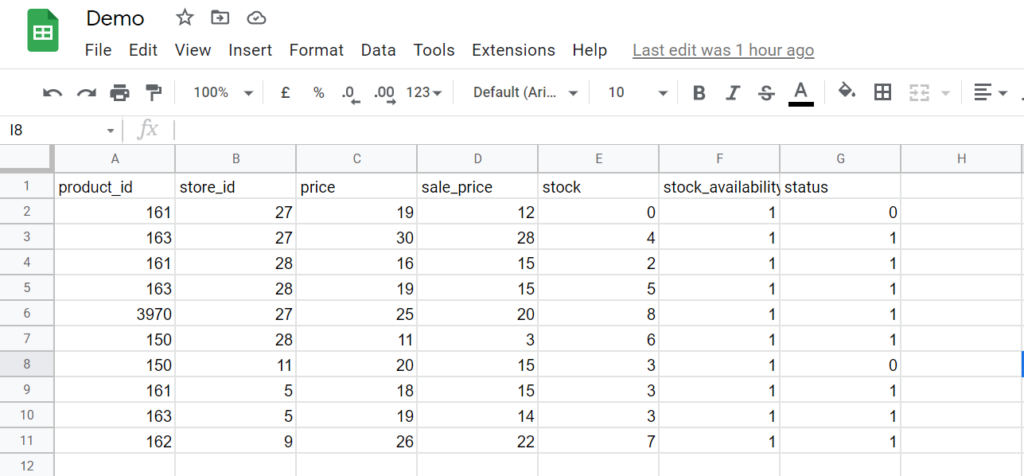
The importer uses the same structure for both manual and automatic imports. Required columns:
| Column | Description |
|---|---|
product_id | Simple Products: WooCommerce Product ID Variable Products: Variation ID |
store_id | ID of the store (from Agile Store Locator’s store list) |
price | Store-specific regular price (optional) |
sale_price | Store-specific sale price (optional) |
stock | Quantity to add to existing stock (integer, positive/negative) |
stock_availability | 1 = in stock, 0 = out of stock |
status | 1 = active, 0 = inactive |
Example CSV #
product_id,store_id,price,sale_price,stock,stock_availability,status
140,11,19,12,12,1,1       # Simple Product ID 140 (Store 11) → +12 stock
140,5,16,15,10,1,1        # Simple Product ID 140 (Store 5) → +10 stock
256,7,20,18,5,1,1 # Variation ID 256 (Store 7) → +5 stock- Simple products: enter the main product ID.
- Variable products: enter the variation ID.
- Stock column values are added to the existing quantity (e.g., if stock = 20 and CSV has 5 → total becomes 25).
- Use negative numbers to decrement stock.
Error Handling #
- If a store is not found → the row is skipped and reported.
- If a product or variation ID is invalid → the row is skipped and reported.
- Errors are shown at the end of the import process (for both manual and automatic imports).


